

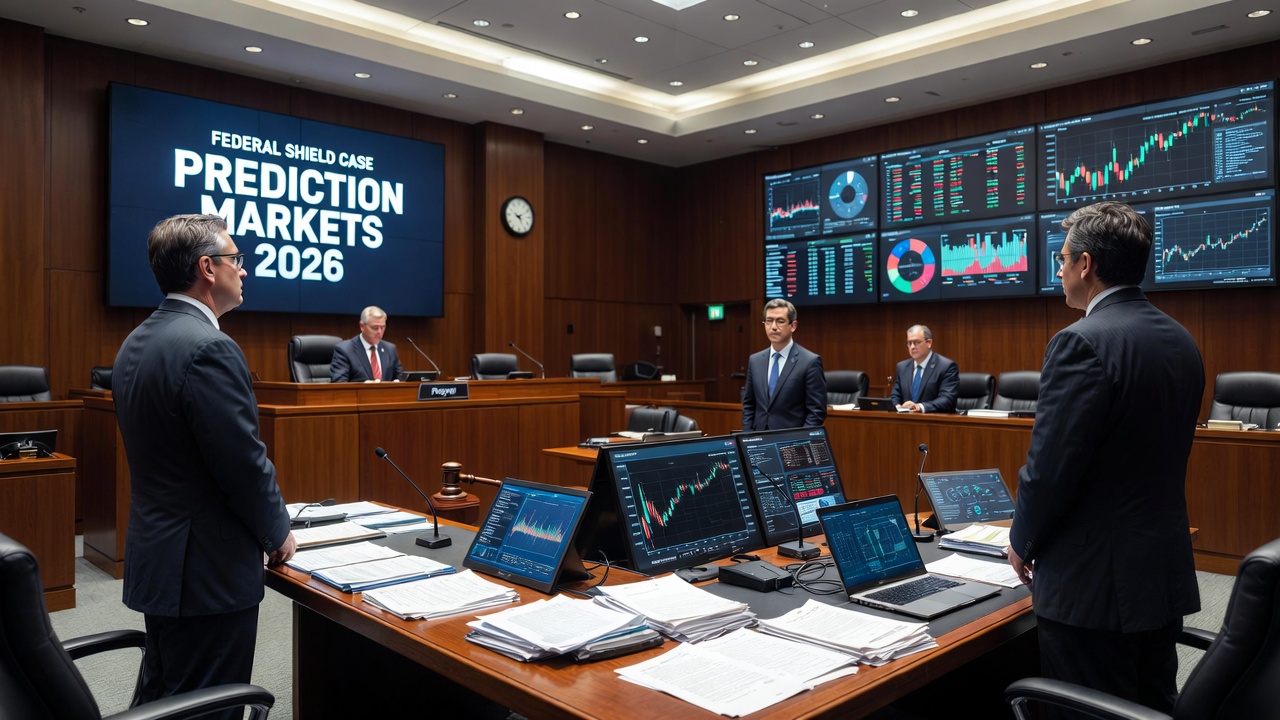
The “Federal Shield” Supreme Court Showdown: Prediction Markets vs. The States
Updated: March 18, 2026
The legal landscape for prediction markets in 2026 has officially shifted from a series of skirmishes into a full-scale constitutional crisis. As of this morning, March 18, the legal teams for Polymarket and its primary domestic competitor, Kalshi, have signaled that the “Great Jurisdictional War” is heading for the highest court in the land. The core of the dispute rests on a concept now known in the industry as the “Federal Shield”—the idea that a federally regulated exchange should be immune from the fragmented, and often contradictory, gambling laws of individual states.
The catalyst for this week’s escalation was a series of aggressive moves by state Attorneys General, most notably in Michigan, Nevada, and Massachusetts. On March 11, Michigan Attorney General Dana Nessel filed a civil enforcement action against Kalshi, labeling the platform an “unlicensed sportsbook.” Nessel’s argument is blunt: if it looks like a bet and pays like a bet, it’s a bet. However, Polymarket’s US entity fired back with a preemptive federal lawsuit in the US District Court for the Western District of Michigan. This “first strike” legal strategy is designed to bypass state courts entirely, moving the fight to a federal stage where the Commodity Exchange Act (CEA) reigns supreme.
Polymarket’s legal team is relying on a three-pronged defense that could redefine financial law for the next decade. First is the principle of Field Preemption. They argue that because Polymarket is a federally registered Designated Contract Market (DCM), the Commodity Futures Trading Commission (CFTC) has sole and exclusive authority over its products. If a state can ban a specific contract on a federal exchange, the argument goes, they could theoretically ban corn futures or oil hedges, effectively destroying the liquidity of national markets. This argument is foundational to the 2026 “Information Finance” thesis, which suggests that decentralized data markets are as vital to national security as the energy grid.
Second is the Reclassification of Risk. For years, critics have called prediction markets “gambling for nerds.” Polymarket is now legally codifying the counter-argument: these are not wagers; they are binary options. They are tools for price discovery and hedging. A farmer in the Midwest might use a weather contract to hedge against a drought; a tech CEO might use a “Regulation Contract” to hedge against a sudden shift in AI policy. By framing these as financial instruments rather than entertainment, Polymarket is attempting to divorce itself from the “Vice Law” category that governs casinos. The legal team has produced over 400 pages of expert testimony arguing that the “intent” of the user—to gain information or mitigate risk—distinguishes these trades from common gambling.
Third is the Irreparable Harm of Geofencing. Modern liquidity requires a unified pool. If Polymarket is forced to “geofence” Michigan, then New York, then California, the market becomes fragmented. The “wisdom of the crowd” fails if the crowd is divided by state lines. This fragmentation, they argue, would destroy the very utility that makes these platforms valuable to the Trump administration’s new economic advisors. The legal filing highlights that fragmented markets are more susceptible to manipulation, whereas a massive, global pool of capital provides a “natural defense” against bad actors trying to skew the price of reality.
Perhaps the most significant development in 2026 is the role of the CFTC itself. Under the leadership of Chairman Michael Selig, the agency has transformed from a cautious observer into a vocal ally of the prediction market sector. Selig, appointed by President Trump, has publicly scolded “overzealous state governments” for attempting to undermine federal authority. In a recent memorandum, Selig noted that the CFTC would no longer sit idly by while states attempt to “tax and regulate the future out of existence.” This federal backing provides the “Shield” that platforms are now holding up against state AGs. For traders, this means that even if a state wins a local court battle, the federal government may intervene to ensure the national exchange remains open. As the case winds its way toward the Supreme Court, the entire $20 billion industry hangs in the balance, waiting to see if “Information Finance” will be granted the same constitutional protections as traditional banking.




0 Comments